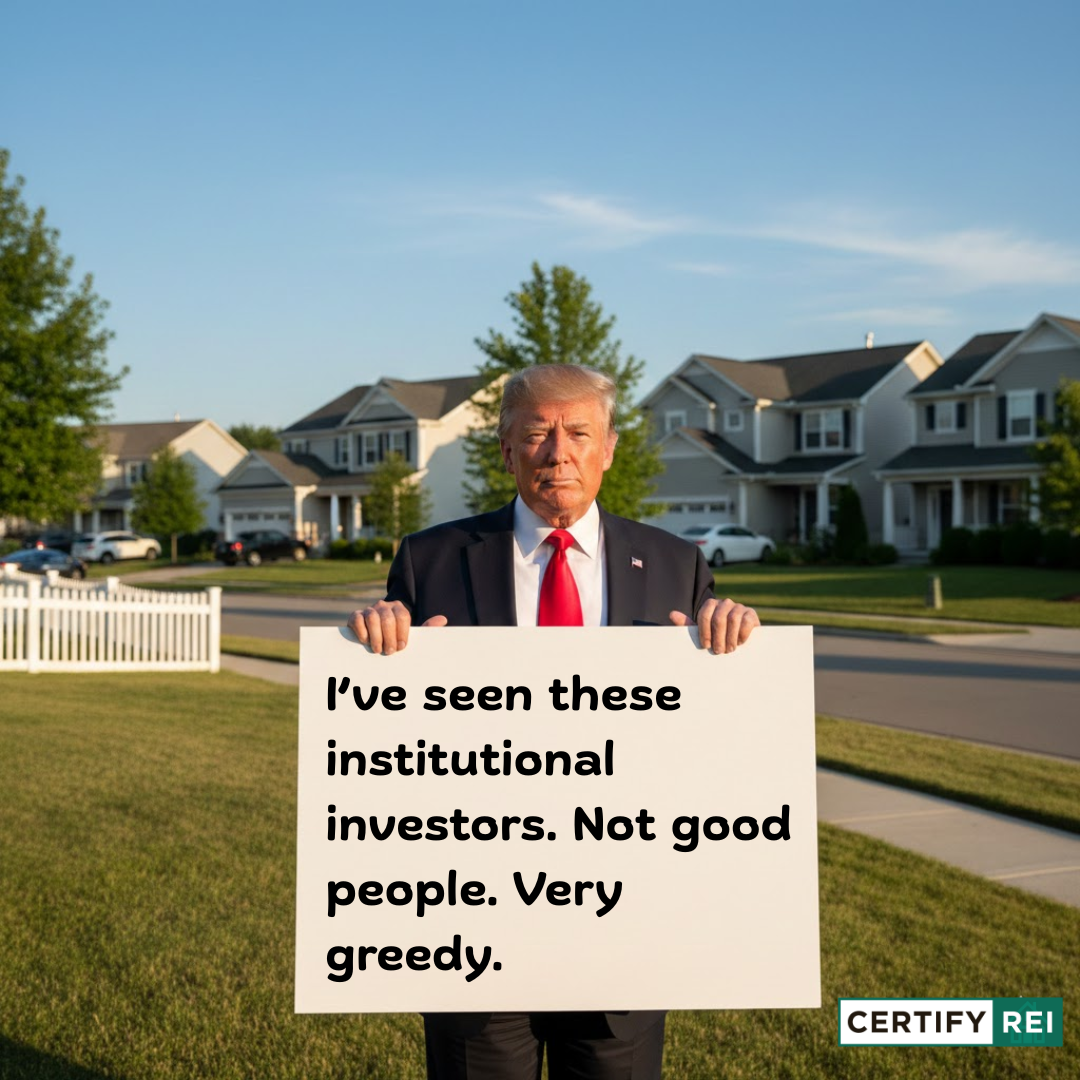
President Trump dropped a bomb on the real estate investment community on January 7th announcing plans to “ban large institutional investors from buying more single-family homes.” The announcement sent shockwaves through investor circles, with reactions ranging from celebration to panic.
But here’s what almost nobody is asking: What does “large” actually mean? And more importantly, will this policy do anything to solve the housing crisis or is it just political theater?
After analyzing the data behind institutional ownership and Trump’s history with Wall Street allies, the answer might surprise you.
What Trump Actually Proposed—And What He Didn’t
The Truth Social Announcement Breakdown
Trump’s statement blamed “record-high inflation caused by Joe Biden” for putting homeownership out of reach and declared he would “immediately” take steps to ban large institutional investors from the single-family housing market. He promised to discuss the policy further at his Davos speech.
What’s notably absent? Any definition of “large institutional investors.”
Key Terms That Matter: “Large” and “Institutional”
This ambiguity is where the real story lives. Most media outlets assumed Trump meant Wall Street giants like Invitation Homes, Tricon Residential, and Progress Residential: the multi-billion dollar REITs that became household names after the 2008 financial crisis.
But corporations come in all sizes. A mom-and-pop investor with an LLC owning 10 rental properties is technically a corporation. So is a regional operator with 500 doors. Where’s the line?
What’s Missing From the Proposal
Trump’s announcement lacks specifics on:
- The threshold for “large” (100 units? 1,000? 10,000?)
- Whether existing portfolios are affected
- How the ban would be enforced
- Whether it applies to build-to-rent communities
- If corporate structures themselves are the issue
Without these details, investors are left guessing and that uncertainty is already impacting decision-making.
The Data Wall Street Doesn’t Want You to See
Who Really Owns Single-Family Rentals in America
According to BatchData’s Q2 2025 Investor Pulse™ report, investors own 20% of U.S. homes. But here’s the kicker: 87% of that market share belongs to smaller investors, not institutional behemoths.
That means the “Wall Street landlord” narrative driving this policy proposal represents just 13% of investor-owned single-family homes.
The 87% Nobody’s Talking About
Mom-and-pop investors, individuals and small LLCs with modest portfolios, are by far the largest owners of single-family rental properties in America. These aren’t faceless corporations with armies of lawyers. They’re everyday investors using strategies like househacking, buy & hold and BRRRR (Buy, Rehab, Rent, Refinance, Repeat) to build wealth.
If Trump’s ban extends beyond mega-institutions, the policy would devastate the very investors who provide the most rental housing stock in the country.
Institutional Investors Are Already Leaving Single-Family
Here’s what the headlines missed: Large institutional investors have been cooling on scattered single-family home purchases for years. They’ve shifted capital toward build-to-rent communities, which offer centralized management and operational efficiency that scattered portfolios can’t match.
Wall Street already decided single-family rentals weren’t worth the hassle. A ban on future purchases might be solving a problem that’s already solving itself.
Why This Ban Probably Won’t Lower Home Prices
The Supply Math Doesn’t Add Up
Thom Malone, principal economist at Cotality, told National Mortgage Professional that “a ban could reduce home prices, but the effect would likely be modest.” Why? Because institutional investors simply don’t represent enough buying pressure to move the needle on prices.
Even if every institutional investor stopped purchasing tomorrow, you’d be removing roughly 3% of housing demand at most. In a market with chronic undersupply issues, that’s a rounding error.
Atlanta: The Only Market Where This Might Matter
Atlanta stands out as the only major market where institutional investors account for more than 10% of purchases. In most metros, their footprint is negligible. A national policy designed to address a localized Atlanta problem seems like using a sledgehammer to hang a picture frame.
What Could Actually Happen to Rents
Here’s the counterintuitive part: Rents could actually increase under this policy. If investor demand drops and slows new construction, rental supply tightens. Reduced supply + steady demand = higher rents. Economic textbook stuff.
This means the policy could inadvertently hurt the very renters Trump claims to be protecting.
The Real Risk Nobody’s Discussing: Definition Creep
When Does a Mom-and-Pop Become “Large”?
This is the question keeping savvy investors up at night. History shows that vague policy language has a tendency to expand over time. What starts as a ban on 10,000-unit operators could morph into restrictions on anyone with more than 50 properties.
Historical Precedent From Local Ordinances
We’ve seen this playbook before at the municipal level. Cities like Minneapolis and Kansas City have implemented investor restrictions that started narrow but gradually expanded to capture smaller operators. Local officials discovered that limiting “institutional” investors was politically popular, so they kept lowering the threshold.
The Corporate Structure Problem
Many small investors operate through LLCs for liability protection. If the policy targets “corporations” broadly rather than defining specific size thresholds, it could inadvertently catch thousands of mom-and-pop operators who simply followed their attorney’s advice about asset protection.
What Wall Street Is Actually Doing While Everyone Panics
The Build-to-Rent Shift
Institutional capital hasn’t left real estate, it’s just changed addresses. Build-to-rent communities (entire neighborhoods of purpose-built rentals) have become the institutional investor’s preferred vehicle. These developments offer:
- Centralized property management
- Economies of scale
- New construction (no deferred maintenance)
- Single-jurisdiction operations
Trump’s proposal says nothing about build-to-rent. If institutions can’t buy existing single-family homes but can still build new rental communities, have we actually accomplished anything?
Why Scattered SFR Portfolios Fell Out of Favor
The 2010s experiment with buying scattered single-family homes taught Wall Street a harsh lesson: operational complexity kills returns. Managing 1,000 homes across 50 zip codes is exponentially harder than managing 1,000 units in one master-planned community.
The market was already self-correcting before Trump’s announcement.
Invitation Homes’ $48M FTC Settlement Context
In September 2024, Invitation Homes paid $48 million to settle FTC charges over misleading rental pricing and unfair eviction practices. This settlement revealed real problems with institutional landlord behavior but it also demonstrated that existing regulatory frameworks can address bad actors without blanket bans.
Do we need better enforcement of existing rules, or do we need new restrictions?
Three Most Likely Outcomes
Scenario 1: Pure PR Play (70% Probability)
Trump announces the policy, takes credit for “standing up to Wall Street,” and the actual implementation either never happens or gets watered down to meaninglessness. This would be consistent with other headline-grabbing proposals that fade after the news cycle moves on.
Scenario 2: Targeted at 1,000+ Unit Operators (25% Probability)
The administration defines “large institutional investors” as operators with 1,000+ single-family homes. This would affect the top dozen or so players while leaving the vast majority of investors untouched. Politically popular, minimal market disruption.
Scenario 3: The Nuclear Option (5% Probability)
A blanket ban on corporate ownership of single-family homes, regardless of portfolio size. This would devastate the rental market, freeze capital formation, and likely face immediate legal challenges. Also the least likely scenario given Trump’s Wall Street connections.
What Investors and Agents Should Do Right Now
Don’t Change Your Strategy—Yet
The key word in Trump’s announcement was “steps” not executive orders, regulations, or legislation. We don’t have policy yet; we have a social media post. Keep executing your current strategy while monitoring developments.
The Davos Speech Will Tell Us Everything
Trump promised to elaborate at his Davos speech in two weeks. That’s when we’ll learn whether this is serious policy or political positioning. Until then, speculation is just noise.
The Bottom Line
Trump’s proposal to ban institutional investors from buying single-family homes sounds bold, but the data reveals a more complex picture. Small investors already dominate the market, large institutions have cooled on the asset class, and the policy’s impact on housing affordability appears modest at best.
The real question isn’t whether this ban will hurt Wall Street, it’s whether the definition of “large” will eventually include the very mom-and-pop investors who provide the bulk of America’s rental housing.
Until Trump defines his terms in Davos, investors should watch carefully but avoid panic. The rental housing market has survived far more dramatic policy shifts than a social media announcement from a president-elect with close ties to the very Wall Street firms he’s threatening to restrict.